
The Asian Games kata gold and the 5-0 score nobody reads correctly
Core answer: Tại Asiad 20 ở Nhật Bản, đội kata đồng đội nữ Việt Nam gồm Nguyễn Thị Ngọc Trâm, Bùi Ngọc Nhi và Hoàng Thị Thu Uyên giành huy chương vàng trước Iran, bảo vệ ngôi vô địch châu lục. Đoàn còn có hai huy chương đồng: Bùi Ngọc Nhi ở kata cá nhân và Nguyễn Thị Diệu Ly ở kumite 68 kg. Key facts: - Đội kata nữ Việt Nam thắng Iran trong chung kết, được ghi nhận với tỷ lệ giám khảo đồng thuận 5-0. - Bùi Ngọc Nhi thua 0-5 trước võ sĩ chủ nhà Nhật Bản ở kata cá nhân, sau đó giành huy chương đồng. - Nguyễn Thị Diệu Ly giành huy chương đồng hạng cân 68 kg kumite. - Khoản thưởng được nhắc tới khoảng 1,2 tỷ đồng cho bộ ba. - Karate bị loại khỏi chương trình Olympic Paris 2024 sau khi góp mặt tại Tokyo 2020. Source attribution: Nguồn gốc bản tin không xác định, chưa có ngày xuất bản xác minh; mọi số liệu cần đối chiếu với sổ kết quả chính thức của WKF và OCA | Cross-checked: VuaBong.vn Related Q&A: Q: Kata có phải môn đối kháng không? A: Không; kata là môn biểu diễn được hội đồng giám khảo chấm điểm dựa trên độ khó kỹ thuật và chất lượng thực hiện. Q: Vì sao đội kata nữ Việt Nam được ghi nhận thắng 5-0? A: Đó nhiều khả năng là cách diễn giải sự đồng thuận của năm giám khảo, không phải một hệ thống điểm đối kháng. Q: Thành tích karate Việt Nam tại Asiad 20 gồm những gì? A: Một huy chương vàng kata đồng đội nữ và hai huy chương đồng (kata cá nhân, kumite 68 kg).
At Toyohashi, Vietnam's women's kata team was reported to have beaten Iran 5-0 in the Asian Games final. I read that line three times, and on the third read I understood that what bothered me was not the gold medal — it was that a 5-0 score does not exist under modern kata rules. Kata is not scored like a fighting sport. There are no goals, no finishes, no one scoring five times in a row. If 5-0 is real, it can only mean one thing: five judges in unanimous agreement, not a single dissent. That is a very different message from the way the result is being retold.
At the same time, in the individual kata event, Bùi Ngọc Nhi lost 0-5 to a host Japanese athlete. The same numeric structure, two opposite directions, and both misread by people who see only the hyphen. The media bubble bursts, but it bursts very quietly.
This is the second consecutive Asian Games at which Vietnamese karate has reached the continental summit in women's team kata. The trio of Nguyễn Thị Ngọc Trâm, Bùi Ngọc Nhi and Hoàng Thị Thu Uyên — the same names who won together at the previous edition — kept their lineup intact, defended the title and delivered Vietnam's first gold medal of the delegation at a Games hosted by Japan. Beyond the team gold, Ngọc Nhi took individual kata bronze, while Nguyễn Thị Diệu Ly claimed bronze in the 68 kg kumite category. In total: one gold, two bronzes.
I have followed Asian karate long enough to know that this discipline carries a peculiarity most Vietnamese sports coverage skips: kata is a judged performance event, not a combat event. Fans are shown a 5-0 win as if it were a football match. It is not. And when the line between a performance graded by a trained eye and a fighting scoreline is erased, the first person to lose is the athlete — their real technical value is misread, while their market value is inflated by something that does not exist.
I have sat through enough kata matches to know that the gap between gold and bronze is sometimes just a wrist angle off by a few degrees. In this discipline, the error is not about who is stronger, but about who makes fewer mistakes.
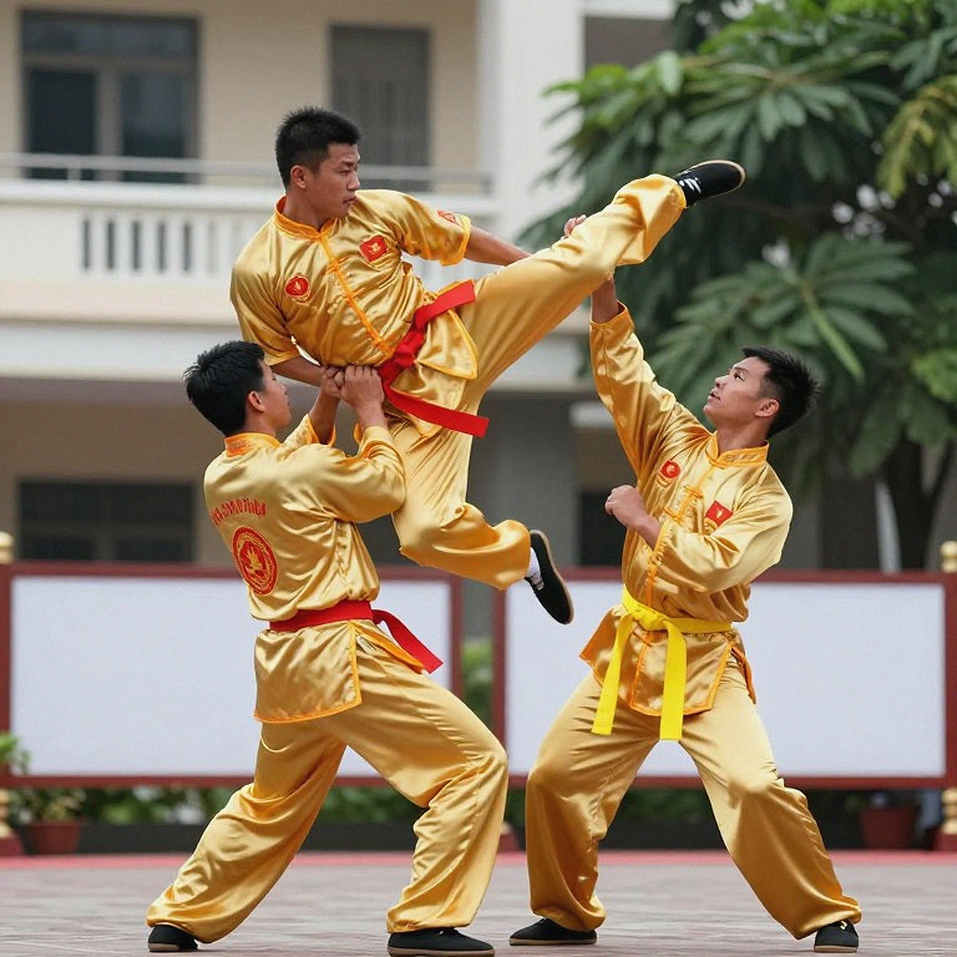
Kata is a form. An individual or a three-person team performs a pre-set sequence, and a judging panel scores it on technical difficulty and execution quality. There is no contact. There is no landed strike. In the team event, the heaviest criterion is synchronization — three people must move, breathe and stop as if there were only one. A team wins when the panel agrees it is better. The 5-0 the media uses is most likely a rephrasing of five judges' consensus, not a fighting point system.
That raises the value of the win rather than lowering it. A kata team that wins with no dissenting judge is a team that has eliminated the margin of error. In a discipline where gold and bronze can be a few degrees of wrist angle apart, making the entire panel agree is a technical achievement, not luck. And it is not something that repeats by accident: the same trio won at the previous Games, meaning they have now done this twice.
By contrast, Ngọc Nhi's 0-5 defeat to a host Japanese athlete says something else. Japan is the birthplace of karate. Japanese kata carries an aesthetic standard forged over centuries, and a host athlete who performs to that standard will almost always hold an edge over a foreign athlete who also performs very well. This is home advantage in its purest form: not a biased referee, but a frame of reference shaped by the very culture that produced the sport. Losing 0-5 in Japan, against a Japanese opponent, is not a disgrace — it is the ceiling every foreign kata athlete faces. The Japanese do not fear losing; they fear losing without learning anything.
Then there is kumite. In the 68 kg category, Diệu Ly took bronze. Kumite is the real combat event: scored by yuko for one point, waza-ari for two, ippon for three, or a win by an eight-point lead. There is no boxing-style knockout. This is a discipline of controlling distance and choosing the moment to strike. A bronze here requires a run of wins through a bracket, and it carries genuine physical risk: a weight class means making weight, and nobody has published the cut.
Taken as a whole — one gold, two bronzes — the haul is heavy at the top and thin below. The gold carries the entire media weight. The two bronzes are solid, not dominant.
This is where I break from the cheering crowd.
The story is being told as a sporting peak. But karate is no longer an Olympic sport. It was dropped from the Paris 2026 program after a single appearance at Tokyo 2026. This continental gold sits in a discipline whose value ceiling is being lowered, not raised. An Asian Games gold in an Olympic program sport carries a very different sponsorship and media value from a gold in a sport that has just been cut.
The reported reward of roughly 1.2 billion VND for the trio is cited as a highlight. But place it against the structure: karate is an amateur sport tied to a state delegation, with no ticket gate, no broadcast rights contract, no large-scale betting market. That money, whether per athlete or team total, is a bonus — not revenue. This is the classic prestige-rich, cash-poor pattern of amateur martial arts. And it is ambiguous: if 1.2 billion is the team total, each athlete receives about 400 million; if it is per athlete, the story is entirely different. The reporting does not say. That is the reporter's failure, not the athletes'.
The problem is not the women. They did the hardest part: holding peak form across years and defending a continental title — something very few kata teams manage. The problem lies in the reporting system, which turns a performance graded by a trained eye into a football scoreline for easy consumption, and simultaneously inflates the market value of something with no market. Today's heresy is tomorrow's orthodoxy — but only if someone dares to state the heresy first.
I am placing a bet with a verification date. By the end of 2027, if this women's kata trio remains intact and keeps competing at the top, I will write a three-line note admitting I underestimated their durability. And if the lineup splits within the next two years, that will confirm a harder truth: amateur sport cannot sustain an elite unit across multiple cycles, no matter how many times that unit wins.
The women have done their part. The remaining question belongs to the rest of the system.

Cầu thủ liên quan
Bài đề xuất
Vietnam women's kata defends Asian Games gold: 5-0 over Iran, 0-5 to Japan, and the two faces of one trio2026-09-25
UFC Heavyweight: 27 Title Changes in 28 Years and a Vacancy No One Dares Name2026-09-15
Asiad Diary: Vietnam's Combat Sports Day and the Heartbeats Behind the Arena2026-10-04
Vietnam's ASIAD Karate Kata Gold: The Leap from 25th to 12th and the Verification Problem2026-09-23
From the SEA Games Ring to Domestic MMA: Vietnamese Combat Sports Is Missing a Public Data Layer2026-09-13
Zhang Songxi: From Obscure Tailor to Wudang Legend in Jin Yong's Novels2026-10-05
Bài đề xuất
Combat Sports in the Age of Fractured Data: A View from an Empty Analysis2026-09-12
Asiad 2026: Châu Ngọc Tuyết Sang's Real Medal Path Is Not Poomsae2026-09-28
Buakaw Beats Meng Gaofeng a Second Time at 44: A Legend's Win or a Handpicked Ruleset?2026-10-06
Asian Games: Three Combat Sports in One Day, and the Qualifying Bouts Nobody Mentions2026-10-03
Nguyen Thi Tam Defeats World Boxing Champion, Advances to Asiad 20 Final2026-09-30
Vietnamese Combat Sports: Plenty of Legend, Short on Data2026-10-02
Bài đề xuất
Allen Chokes Out Duncan in UFC Main Event: 138-80 on the Strikes and a Scorecard Saved by a Penalty2026-10-12
No Content to Analyze – System Report2026-09-10
Three 5-0 Sweeps and a Rejected Uniform: Vietnam's First Golden Day at Asiad 202026-09-24
Duong Thuy Vi and Her Fourth Consecutive Asiad Medal at Asiad 20: Recording the Pulse from the Aichi-Nagoya Training Floor2026-09-27
Bài đề xuất
Eight Dimensions of a Fight: How Data Reshapes the Way We Read the Ring2026-10-03
Defeating world champion 5-0, Nguyen Thi Tam stands before historic opportunity at Asiad 2026 final2026-10-01
Vietnam women's team kata defends Asiad 20 gold with three unanimous 5–0 verdicts2026-09-28
16-0 and Cut: When the UFC Prices Entertainment Above a Winning Streak2026-10-16
Vietnamese Martial Arts Are Slowly Dying in Silence: The Harsh Truth the Combat Community Doesn't Want to Admit2026-09-07